


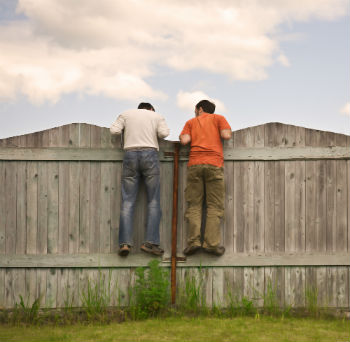
 Neighbor disputes are expensive, time consuming, and there is no attorneys’ fees provision. The recent case of Madani v. Rabinowitz is one where the misplaced fence was moved, and the wronged neighbor received no damages.
The Facts:
Mr. Madani sued his neighbor for trespass and nuisance after he had a survey done and learned that the shared fence encroached on his side of the property and that Mr. Rabinowitz was parking cars on his property.
In California, the statute of limitations for bringing a trespass claim is three years. (Code Civ. Proc., § 338, subd. (b).) The same three-year statute of limitations applies to private nuisance claims.
1884 Hits
1884 Hits
 In California, a landowner has no enforceable property rights to an unobstructed view. That means, you can’t force your downhill neighbor to trim their trees. However, I have seen the occasional CC&R’s from planned communities that restrict heights of trees, plantings, and structures to ensure that the homeowners can enjoy their view.In those circumstances, the restrictive covenants are strictly construed against the person seeking to enforce them. American jurisprudence favors alienability and free use of land so that will be the default legal view.
 Neighbor disputes over shared boundaries can arise over a misplaced fence, a shared driveway, or water rights. These claims are heavily fact-based and often the accuracy of the modern survey can only be overcome with meeting the elements for adverse possession or prescriptive easement.